Ana-Maria Boromisa, PhD, participated in the European Geothermal Workshop (EGW) 2026, held from 29 September to 1 October 2026 at the Institute of Applied Geosciences of TU Darmstadt in Germany. The workshop brought together researchers, engineers, and industry professionals from around the world to discuss the latest advances in geothermal energy research and applications. The central theme of this year’s event was “Utilization of the Basement,” focusing on the use of deep geological formations for geothermal energy development.
The European Geothermal Workshop is one of Europe’s leading scientific events in the field of geothermal energy. The 2026 edition was hosted by TU Darmstadt and co-organized by the Karlsruhe Institute of Technology (KIT), the Helmholtz Centre for Geosciences (GFZ), and the Helmholtz Centre for Environmental Research (UFZ). The programme featured sessions on geothermal exploration, geothermal engineering, numerical modelling, laboratory and field experiments, and the societal and economic dimensions of geothermal energy development.
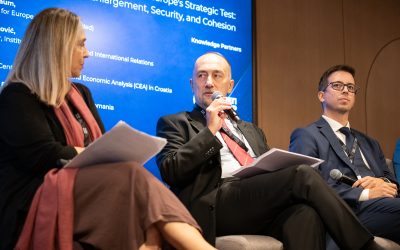
Dr. Boromisa presented the paper “Does Geothermal Drilling in Lagging Regions Translate into Local Development?”, co-authored with V. Vučković, during the session “Geothermal Energy in Society and Economy.” The research examines whether investments in geothermal exploration and drilling can contribute to economic development in less-developed regions by generating employment opportunities, attracting new investments, supporting infrastructure development, and stimulating local economic activity.
The session highlighted the broader societal and economic impacts of geothermal energy and its role in supporting the energy transition. As geothermal energy provides a reliable, low-carbon source of heat and electricity, understanding its regional development effects is becoming increasingly important for policymakers and investors seeking to maximize the benefits of renewable energy projects.
Following the scientific programme, participants joined an excursion to EnBW’s geothermal facility in Bruchsal, one of Germany’s best-known geothermal projects. The visit included a tour of the geothermal power plant as well as a pilot facility for lithium extraction from geothermal brine. Such projects are attracting growing international interest because they combine renewable energy production with the recovery of critical raw materials needed for battery manufacturing, thereby enhancing both the economic and strategic value of geothermal resources.
Participation in EGW 2026 provided an opportunity to exchange knowledge with leading European experts in geothermal energy and to present research findings on the contribution of geothermal investments to regional development and the broader energy transition.
For more information see. https://egw2026.eu/